 Venice Photoshoot
Best Time for Photos in Venice
The best time for photos in Venice is not the season most guides claim it is, because the one number everyone quotes, golden hour, barely changes between December and June at this latitude. What actually shifts through the year is the angle of the sun, the size of the crowd and whether a tide forecast puts water on the Piazza San Marco pavement, and all three of those are documented rather than guessed. This guide works from the US Naval Observatory's own sun-position data, the Comune di Venezia's tide thresholds, and the city's official Annuario del Turismo arrivals table, so the month you pick can be a decision rather than a hunch. Every Venice photoshoot package we track publishes a start window you can match to what follows.
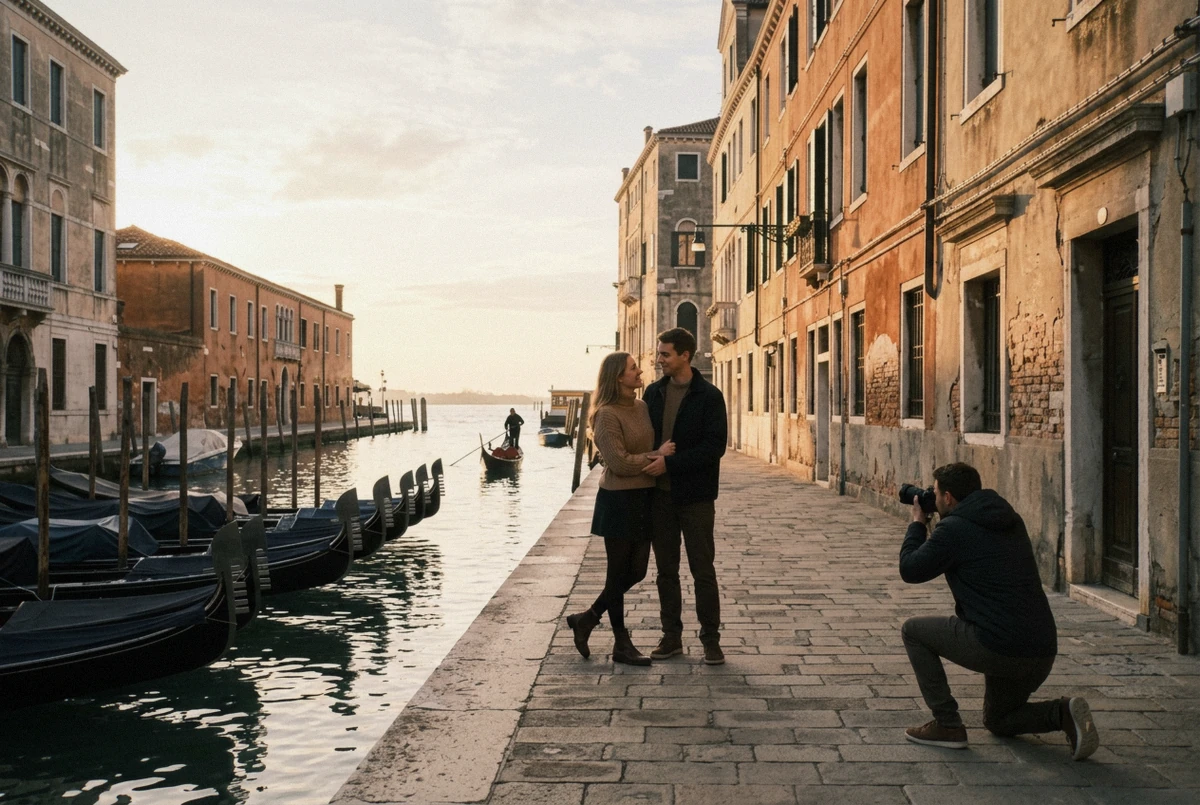
Quick answer Golden hour barely moves; the sun angle, tides and crowds do
Golden hour in Venice runs about 40 to 44 minutes all year, so chasing a longer window by season is chasing the wrong number. What genuinely changes is the sun's angle at noon, low and raking in winter, high and hard by June, plus the crowd calendar and the tide forecast, both of which are published well in advance.
Key takeaways
- Golden hour lasts about 40 to 44 minutes narrow, 67 to 71 minutes wide, essentially all year, December beats June by only two to four minutes, not by an hour
- What actually changes is the noon sun: 23.5° in mid-January against 67.9° in mid-June, which is why winter light stays low and raking all day
- October is not shoulder season: 382,596 arrivals against September's 382,496, practically the same month
- Acqua alta is schedulable, not a ruined trip: Piazza San Marco floods from 82 cm (about 32 in), a 120 cm peak clears in under 1.5 hours, and the peak is forecast days ahead
- The earliest bookable start in this catalogue is 05:00, on the cinematic hidden-gems session
- For where to point the camera once the hour is decided, see our Venice photo-spot map
The Finding: Golden Hour Barely Moves in Venice
Most travel advice claims golden hour runs far longer in winter than in summer. At Venice's latitude, computed with the NOAA solar-position algorithm for 45.4408°N, 12.3155°E, that claim does not hold up, and it matters which definition of golden hour is being used.
Using the narrow definition, the sun sitting between 6° above the horizon and the horizon itself, morning golden hour runs 43 minutes on 15 December against 40 minutes on 15 June, and the evening window runs 44 minutes against 40 minutes on the same two dates. Using the wider definition most photo apps report, 6° above the horizon down to 4° below it, the same two dates give 71 minutes in December against 68 minutes in June.
Either way, the honest framing is that the window is essentially constant across the year, roughly 40 to 44 minutes on the narrow definition and 67 to 71 minutes on the wide one, and mid-December beats mid-June by two to four minutes, not by the hour the internet usually claims.
Sunrise, Sunset and Day Length, Month by Month
The table below is computed for 2027 using the US Naval Observatory's solar-position data for Venice's coordinates; the times shift by only one to two minutes in other years, so they hold up as a planning reference regardless of which year you actually travel. Daylight saving time runs 28 March to 31 October in 2027, and the switch moves sunset from 18:32 to 19:33 overnight, the single biggest one-day change on the whole calendar, worth checking if your dates straddle either date.
| Month (15th) | Sunrise | Sunset | Day length | Twilight ends |
|---|---|---|---|---|
| January | 07:47 | 16:53 | 9h 06m | 17:27 |
| February | 07:13 | 17:37 | 10h 24m | 18:08 |
| March | 06:24 | 18:16 | 11h 52m | 18:46 |
| April | 06:26 | 19:56 | 13h 30m | 20:27 |
| May | 05:41 | 20:34 | 14h 53m | 21:09 |
| June | 05:22 | 21:01 | 15h 39m | 21:39 |
| July | 05:37 | 20:56 | 15h 19m | 21:33 |
| August | 06:11 | 20:19 | 14h 08m | 20:51 |
| September | 06:49 | 19:23 | 12h 34m | 19:52 |
| October | 07:26 | 18:26 | 11h 00m | 18:56 |
| November | 07:09 | 16:41 | 9h 32m | 17:13 |
| December | 07:43 | 16:28 | 8h 45m | 17:02 |
What Actually Changes With the Season: the Angle of the Sun
This is the payoff of the finding above. Noon sun altitude is 23.5° on 15 January against 67.9° on 15 June. In mid-winter, the sun never climbs much above 23° over Venice, so the light stays low and raking through the whole day and a midday session is genuinely usable. By mid-June it reaches nearly 68°, hard vertical light that pushes most sessions to the ends of the day instead.
The second real difference is how many usable hours a day holds at all: 8h 45m of daylight in mid-December against 15h 39m in mid-June, from the table above. The third is direction. On 15 June the sun rises at azimuth 54.6° and sets at 305.5°, well north of due east and west; on 15 January it rises at 119.9° and sets at 240.2°, far to the south, which changes which canal and which façade actually catches the light through the day. A frame that worked in July is not available in the same way in January.
Blue hour is short at this latitude regardless of season, about 15 minutes on 15 June and 13 minutes on 15 December, so a blue-hour plan is really a 13-minute plan either way.
The Best Hour to Book, and Who Actually Starts Then
Matching a time window to a real, bookable start is more useful than an abstract best hour, so the table below uses only published start times from this site's own catalogue. Five of the eleven listings on this site publish no fixed slot at all and instead print "check availability to see starting times," which is worth knowing before you assume every session opens at dawn.
| Window | Summer clock | Winter clock | What it gives you | Who starts there |
|---|---|---|---|---|
| Pre-sunrise / civil twilight | About 04:45 | About 07:15 | Empty landmarks before the crowd arrives | Book that early slot directly, which opens at 05:00 |
| Sunrise hour | 05:22-06:22 | 07:43-08:43 | Low, warm light, still few people | The artistic session offers a sunrise option, with the exact start fixed the day before |
| Mid-morning | 08:00-10:00 | 09:00-11:00 | Light softening, crowds building | No listing publishes a mid-morning-specific start |
| Midday | 12:00-14:00 | 12:00-14:00 | Hard vertical light in summer, usable raking light in winter | The proposal and gondola shoot prints a midday gap, 07:00-12:30 then 14:00-20:30, telling you what the operator thinks of noon light |
| Golden hour | 19:20-21:00 | 16:05-16:50 | The safest booking, shared with everyone else who read the same advice | No fixed-slot listing targets it specifically |
| Blue hour | 21:00-21:15 | 16:50-17:05 | Cinematic and short, about 13 to 15 minutes | Natural-light-only photographers can genuinely struggle here without flash |
Two fixed-format sessions round out the published windows: the flying-dress shoot runs 07:00-21:00 and the wedding and engagement photographer starts at a fixed 07:30, with the operator's own listing stating he knows the best timing to avoid the crowd. The Comune's day-tripper access fee, when it applies, runs 08:30-16:00, which is the municipality's own administrative window for when day visitors are in the city; that specific time range is widely reported but was not confirmed verbatim on an official page, so treat it as a strong signal rather than a citation.
Which Window Fits Your Priority
If you want empty landmarks and the lowest light
book sunrise; it costs a 05:22 alarm in June and only a 07:47 one in January, and it is the window the earliest-starting sessions are actually built around
If you want the safest, most reliable booking
golden hour, at roughly 40 minutes, is dependable but shared with everyone else who read the same advice, so expect company
If you want a cinematic, moodier look
blue hour delivers it in 13 to 15 minutes, and it is the one window where a natural-light-only photographer can genuinely fail; one November booking on this site's catalogue came back dark and underexposed for exactly that reason
If you want the mirror-reflection Piazza San Marco shot
that needs water on the pavement, so it is deliberately scheduled onto a forecast above 82 cm rather than around one, and it is schedulable because the Comune publishes the peak in advance
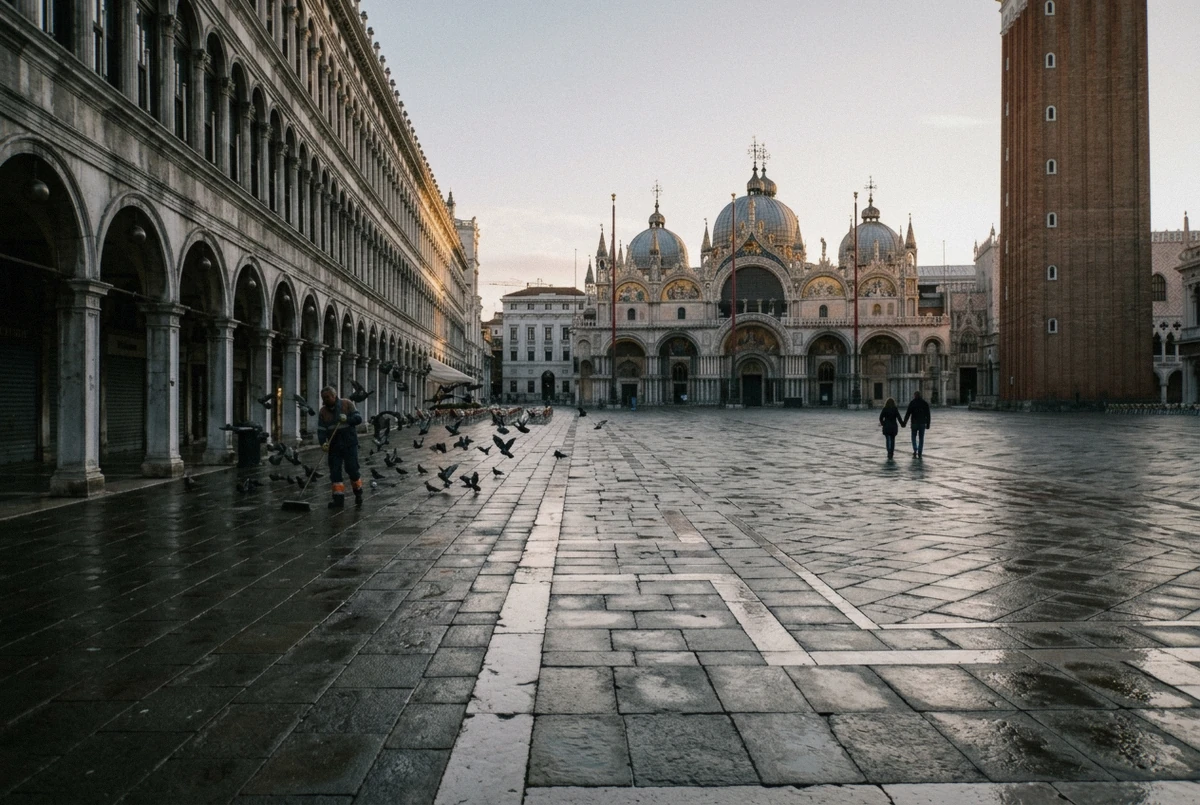
Acqua Alta Is a Two-Hour Problem, Not a Ruined Trip
Every figure in this section is official, measured against the zero mareografico di Punta della Salute, the 1897 tide datum. Piazza San Marco starts to flood above 82 cm (about 32 in). The Basilica narthex and the pavement in front of it take water from 60 cm (about 24 in), which happens more than 250 times a year. At 90 cm (35 in) almost two thirds of the Piazza is under water, and at 100 cm (39 in) it is almost completely submerged, on average 7 times a year. Rialto floods at 105 cm (41 in), the station area at 135 cm (53 in), and public transport reroutes above 95 cm (37 in).
MOSE, the mobile barrier system, closes on forecasts above 110 cm (43 in). That is the honest correction to "MOSE fixed the flooding": the Piazza still floods from 82 cm and the Basilica narthex from 60 cm, both well under the barrier's own threshold, so the most common, lower-level floods still happen exactly as before. That is also why the marquee backdrop, Piazza San Marco, is the first location on any Venice itinerary to go under.
Scheduling around it is more realistic than it sounds. An event peaking at 120 cm (47 in) keeps water above street level for less than 1.5 hours, per the Comune's own figure, and walkways stay passable up to that same 120 cm level. Peaks are published in advance in the daily bulletin from the Centro Previsioni e Segnalazioni Maree, sirens sound about three hours ahead of the peak, and free SMS alerts go out for any forecast at or above 110 cm. Seasonally, about 75% of tides at or above 110 cm fall between October and December, peaking in November, while July and August have never recorded one and June has recorded a single event, back in 2002. The Comune's own framing is the right one to borrow: an ordinary and transient natural phenomenon, not a trip-ending event.
Crowds by Month: October Is Not Shoulder Season
The figures below are the Comune di Venezia's own Annuario del Turismo 2023 data for the historic centre, counting overnight guests only, not the day-trippers who make up the bulk of the daily crowd. They are three years old but structurally stable.
| Month | Arrivals (historic centre) | Overnights | What it means for a session |
|---|---|---|---|
| January | 168,941 | 419,080 | The quietest month of the year |
| February | 220,655 | 551,471 | Still quiet outside Carnival dates |
| March | 273,640 | 665,228 | Building toward the spring plateau |
| April | 352,906 | 884,970 | Enters the busy April-October plateau |
| May | 357,301 | 887,619 | Plateau continues |
| June | 393,251 | 905,704 | Approaching the year's busiest stretch |
| July | 426,112 | 945,789 | The single busiest month, 2.52 times January |
| August | 404,218 | 911,450 | Still near the year's peak |
| September | 382,496 | 906,214 | Widely assumed quiet; the data disagrees |
| October | 382,596 | 931,733 | Effectively identical to September, and the second-highest overnight count of the year |
| November | 241,951 | 585,739 | A 36.8% drop from October in a single month |
| December | 213,228 | 496,694 | Quiet again outside the holiday weeks |
The correction worth printing plainly: October is essentially as busy as September, 382,596 arrivals against 382,496, a gap of only 100 people, and it carries the second-highest overnight count of the entire year at 931,733. The idea of a quiet autumn does not survive the data. The genuine cliff comes a month later, October to November, a drop of 36.8% in a single month.
What the arrivals table cannot give you, and this site's own catalogue can, is how photographers actually dodge whatever crowd is on the ground that day, which is the single most-praised skill across our eleven listings and the subject of what to expect on a Venice photoshoot.
Rain, Fog and Heat: What the Normals Say
These figures are the 1971-2000 normals from the Aeronautica Militare's climate atlas, recorded at the Venezia Tessera airport station, not current-year weather. Treat them as a typical baseline and check the forecast closer to your actual dates.
| Month | Mean daily max | Rain days | Fog days |
|---|---|---|---|
| January | 6.6 °C (44 °F) | 6 | 13 |
| February | 8.6 °C (47 °F) | 5 | 8 |
| March | 12.5 °C (55 °F) | 6 | 5 |
| April | 16.1 °C (61 °F) | 8 | 4 |
| May | 21.5 °C (71 °F) | 8 | 1 |
| June | 24.9 °C (77 °F) | 9 | 1 |
| July | 27.7 °C (82 °F) | 6 | 1 |
| August | 27.5 °C (81 °F) | 6 | 1 |
| September | 23.5 °C (74 °F) | 6 | 3 |
| October | 18.0 °C (64 °F) | 7 | 6 |
| November | 11.6 °C (53 °F) | 6 | 8 |
| December | 7.4 °C (45 °F) | 6 | 10 |
Three readings matter more than the raw numbers. Rain days are remarkably flat, 5 to 9 per month, so Venice has no real dry season, and June actually has the most rain days of any month at 9, with 78.0 mm of total rainfall, the wettest month of the year by volume. Fog is a November-to-February phenomenon, 13 days in January, and effectively absent from May through August at one day a month.
Heat is genuinely real in July and August, both around 27.6 °C (82 °F) on the mean daily max, with 16 days a year reaching 30 °C (86 °F) or more. Two caveats worth carrying: the station sits at the airport on the mainland lagoon edge, a classic fog site, so treat the fog figures as a seasonal pattern rather than a day-count promise for the historic sestieri, and a newer climate baseline runs about 1 °C warmer than these normals.
The Week Before Your Session
Every line below is traceable to a fact above.
- Check the tide bulletin at the Centro Previsioni e Segnalazioni Maree the evening before, and again the morning of
- If the forecast peak is above 82 cm, decide in advance to either avoid that location or deliberately shoot it
- Sign up for the free SMS alert if your dates fall October to December, when about 75% of the year's high tides cluster
- Confirm whether your dates straddle the late-March or late-October clock change, since sunset moves by an hour overnight
- Check sunrise for your actual travel date against the month table, not for the month you booked in
- Agree a firm go or no-go time with your photographer if rain is forecast, since only one listing in this catalogue prints a rain-reschedule clause
- Book a daylight slot rather than a late-afternoon one in late autumn and winter, when the window closes fast
Best Time for Photos in Venice: More Questions
What is the golden hour in Venice?
About 40 to 44 minutes on the narrow definition, 67 to 71 minutes on the wide definition most photo apps use, and that length barely changes across the year. Mid-December beats mid-June by only two to four minutes, not the hour many guides claim.
When's the worst time to go to Venice?
July and August combine the year's heaviest heat, a mean daily max around 27.6 °C (82 °F), with crowds near their annual peak. October is not the quiet alternative it is often billed as; its arrivals sit almost exactly level with September's.
What time does Venice get less crowded?
The day-tripper access fee, when it applies, runs roughly 08:30 to 16:00, which is the city's own administrative definition of the crowded hours. The earliest-starting session in this catalogue takes bookings from 05:00, well before that window opens.
What month has the best light for photos in Venice?
Every month has roughly the same golden-hour length; the real variable is the sun's angle. Winter's low noon sun, 23.5° in mid-January against 67.9° in mid-June, keeps the light raking and usable through the whole day rather than only at the edges.
When is acqua alta in Venice and will it ruin a photoshoot?
Piazza San Marco floods above 82 cm, and about 75% of the year's high tides cluster October to December. A typical event peaking at 120 cm clears in under 1.5 hours, and the Comune forecasts the peak days ahead, so it is schedulable rather than trip-ending.
What time do Venice photoshoots start?
It depends on the listing. The earliest opens at 05:00 and another offers a sunrise start with the exact time fixed the day before; several other listings publish no fixed slot at all and confirm the time after booking.
Where should I actually point the camera once I've picked the hour?
That is a separate question from timing. Our full spot-by-spot map of Venice covers the inventory of locations and which light suits each one.
The month you come changes the angle of the light and the size of the crowd, not the length of golden hour, whatever the last blog you read claimed. Pick the hour from the tables above, check the tide the night before if you are anywhere near San Marco, and the rest is a photographer's job. The full Venice photoshoot comparison is the fastest way to match that hour to a session.