 Venice Photoshoot
What to Wear for a Venice Photoshoot
What to wear for a photoshoot in Venice comes down to one honest test: can you still walk it in an hour, sit on a stone step in it, and climb three more bridges without wincing. The city's own tourist board counts over 430 bridges linking its islands, and every route between locations crosses several of them, so the outfit that photographs best here is rarely the outfit that looks best folded in a suitcase. This guide pulls together what several Venice photographers actually publish about colour, fabric and shoes, attributes every opinion to the person who holds it, and adds the one official rule, from the Basilica itself, that ends the argument about heels for good. For the sessions themselves, the Venice photoshoot sessions we compare run from a 30-minute couple's shoot to a half-day wedding booking, and the wardrobe advice below applies to all of them.
Quick answer Colours, fabrics, shoes and the one church rule that matters
Wear Venice's own palette back at it, warm neutrals and muted jewel tones rather than anything neon, in a fabric that survives a gondola seat and a dozen bridge steps, and bring two pairs of shoes rather than one. The one rule that actually ends an argument is official: St Mark's Basilica bars professional photography inside, so dress for it on your own visit, not for the shoot.
Key takeaways
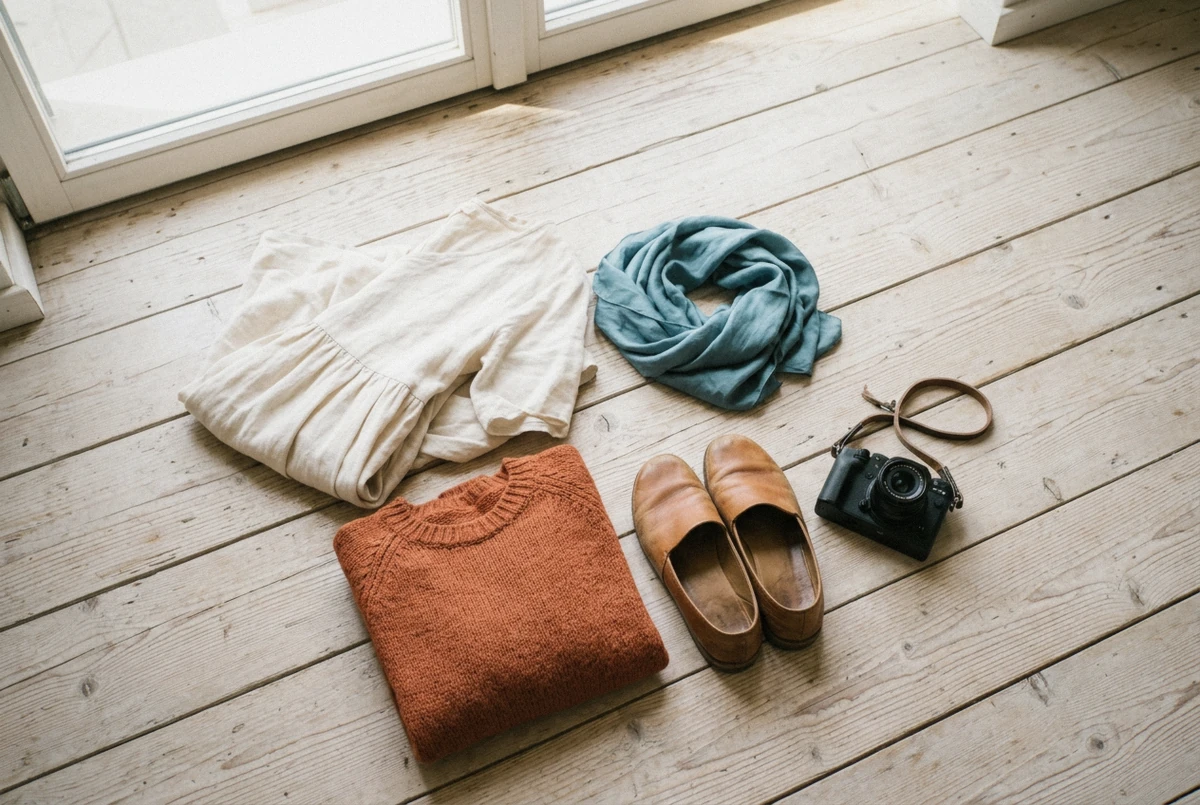
- Lean into the city's warm neutrals, terracotta, ochre and sage, rather than anything bright; photographer Silvia Sala names beige, brick, ochre, sage and teal as the tones that sit inside Venice's own colour palette
- Bring two pairs of shoes, since the city stitches its islands together with over 430 bridges and a stone step is not a heel's natural habitat
- St Mark's Basilica's own visitor rules bar professional-grade photography inside the building entirely, so treat it as somewhere to dress for on your own visit, not somewhere your photographer will actually shoot
- Only the 90-minute Super Premium tier buys time for a full outfit change on this site's catalogue; on a shorter booking, plan on wearing one outfit well, the way the flying-dress toss is built around a single striking look rather than several
- What suits the light shifts by month, so check the best time for a Venice photoshoot for your travel dates before you finalise the wardrobe
Venice's Own Palette, and the Colours That Sit Inside It
Venice photographs as a warm neutral city before it photographs as anything else: golds, creams, terracotta and stone, the way photographer Camilla M. describes the backdrop on her own Venice styling page. Three Venice-based photographers publish a version of that same idea, each with a slightly different list.
Silvia Sala frames the wardrobe as neutral, earthy or muted, and names beige, brick, ochre, sage and teal as the shades that sit inside Venice's natural palette, with jewel tones such as emerald, burgundy or navy working well when a stronger colour is wanted. Camilla M. leans toward soft pastels, blush pinks, lavender and baby blues, alongside earthy beige, taupe and olive, and jewel tones she names as emerald, sapphire and amethyst. CB Photographer Venice keeps it simpler again: cream, beige or soft earth tones that blend naturally with the architecture, with darker shades reading as slimming and lighter colours reading fresh in summer.
The guiding line, in Silvia Sala's own words, is that simplicity wins: a clean, well-fitting outfit in a beautiful tone looks more elegant on camera than a busier one. That is the thread running through all three lists, whichever exact palette a reader picks.
What to Leave in the Suitcase, and Why
Every reason below is attributed, because it is one photographer's stated preference rather than a house rule. Silvia Sala advises against neon or overly bright colours because they distract from the intimacy of a portrait and clash with Venice's muted tones, naming canary yellow and fuchsia specifically as the two worst offenders. Camilla M. gives the same instruction in different words, warning against neon colours, large logos and overly bright hues that clash with the city's ambiance.
CB Photographer Venice adds a second, more technical reason to avoid a hard contrast: pure white worn against black tends to look too harsh in photographs, and large logos, bold graphics or cartoon characters shift attention away from the face rather than toward it. Silvia Sala makes the same point about logos in her own words, calling large logos or bold lettering loud or out of place against Venice's architecture.
Couples get one more rule worth printing: mismatched styles between two people break the cohesion of a shot. The fix several photographers give is not to match outfits but to coordinate them, one patterned and one solid, in a shared palette worn in different shades, using similar fabric weights such as linen, cotton or silk so the two outfits read as a pair rather than a coincidence.
Fabrics That Move on a Bridge and in a Gondola
Photographer in Venice states the movement test in the most specific terms available anywhere in this research: the outfit has to let you walk, sit on the stone steps of bridges or in a gondola, and pose without pulling, which rules out anything tight, stiff or restrictive before colour ever enters the conversation.
Long, flowing silk and chiffon pass that test and add something a stiffer fabric cannot: they read as movement in a photograph and catch the breeze coming off the water, a detail CB Photographer Venice and Camilla M. both call out separately. For men, linen suits the warm months in the same way, and a light shawl or extra layer earns its place in the bag for the wind on the water, a detail venezia.photography adds on top of the fabric advice.
Accessories follow the same logic as the fabric: refined jewellery only, small earrings, a delicate necklace or a thin bracelet, and no watch, because a watch catches the light and pulls attention away from the face rather than toward it. Soft waves read better on camera than a stiff hairstyle, and make-up applied a shade stronger than usual, since it tends to photograph lighter than it looks in the mirror.
Shoes: 430 Bridges and Uneven Stone
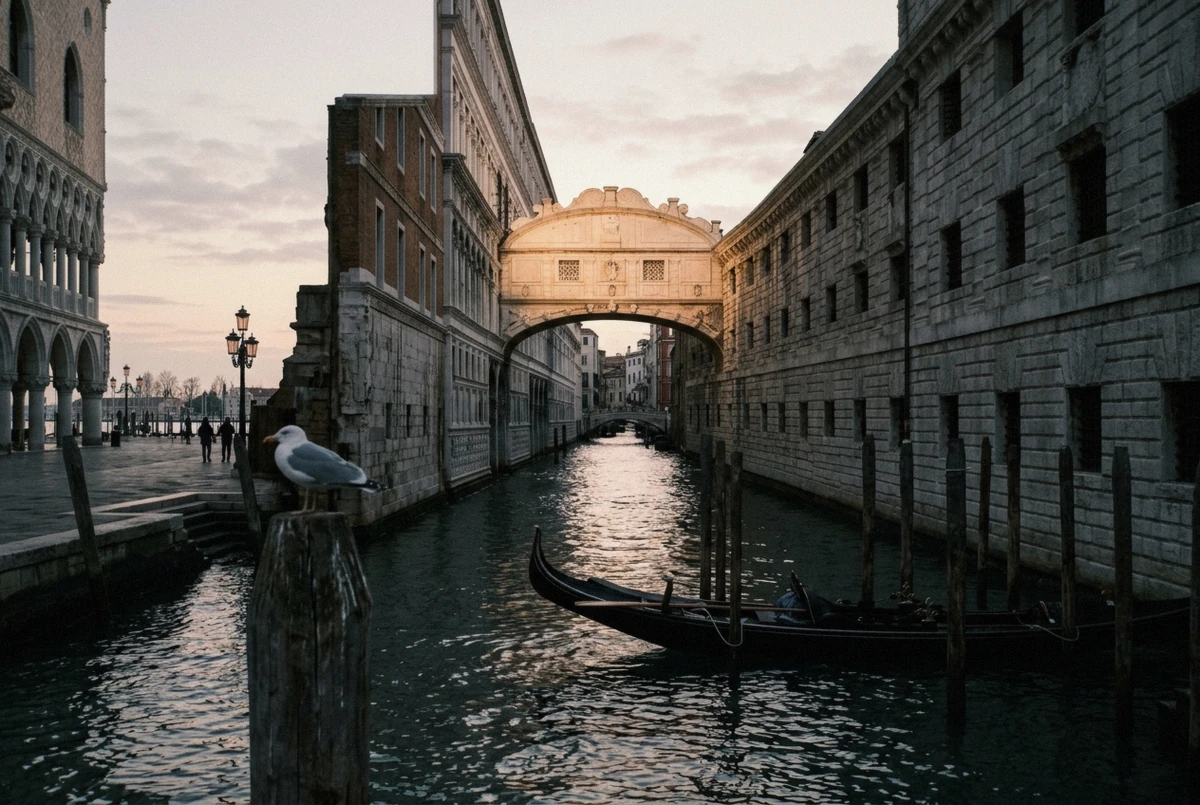
Start with the scale of the problem. Venice's own tourist board counts over 430 bridges connecting the islands that make up the city, and any session that moves between two or three locations crosses several of them, each one a run of uneven stone steps.
The photographers disagree honestly about what to put on your feet, and it is worth printing both sides rather than picking one.
| Photographer | Recommends | Why |
|---|---|---|
| CB Photographer Venice | Two pairs: heels for the shot, flip-flops for walking | Wants heels visible in the frame, since they elongate the figure |
| Photographer in Venice | Flats, loafers or low-heeled boots | Says the paving is not ideal for high heels |
| Camilla M. | Block heels | Navigates cobblestones while still looking dressed-up |
| St Mark's Basilica (official) | No heels inside the monument | The visitable route has passages that are narrow and steep |
One photographer publishes the practical workaround for anyone still set on heels: stage them near your hotel and change into them for a handful of frames, rather than wearing them for the whole route. Men across all three guides get simpler advice than the women's debate above: loafers, brogues or leather shoes for the photographs, sneakers for the walking in between.
What ends the argument, though, is not a photographer's opinion but an official rule. St Mark's Basilica's own regulation advises against heeled shoes for a safety reason, not a style one: the visitable route includes passages that are very narrow and steep, and the wrong shoe there is a genuine hazard rather than an aesthetic choice.
What to Wear Month by Month
The numbers below are the 1971-2000 normals for Venice's Marco Polo airport station, published by the Aeronautica Militare's own climate atlas. They describe a typical day for that season, not the forecast for any specific date, so check the actual conditions closer to your travel dates on top of this table.
| Season | Typical day | What it feels like | What to wear | What to add |
|---|---|---|---|---|
| Winter (Dec-Feb) | 8.6 °C / 47 °F max, 0.8 °C / 33 °F min in February | Cold, damp, with 8 fog days in February alone | Tailored coats, wide-leg trousers, soft knits, per Silvia Sala's own winter list | Wool scarves, gloves and a structured hat |
| Carnival (February) | Same cold, damp February range as above | Photographer in Venice calls it a misty, almost ethereal look that suits layering | The same winter layers, plus a rented mask or costume if you plan one | See renting a historical costume before the trip |
| Spring (Mar-May) | Rising from a 12.5 °C / 55 °F March max toward 21.5 °C / 71 °F in May | Milder, still a chance of rain most months | Softer pastels, per Photographer in Venice's spring guidance | A light layer for cool mornings |
| Summer (Jun-Aug) | 27.7 °C / 82 °F mean max in July, the year's hottest month | Hot and muggy, with 16 days a year reaching 30 °C / 86 °F or more | Light, breathable dresses and linen shirts, per Silvia Sala's summer list | A wrap for cooler mornings and evenings, since the café warm-up option barely exists at dawn when the bars are still shut |
| Autumn (Sep-Nov) | Falling from 18.0 °C / 64 °F in October to 11.6 °C / 53 °F in November, with 7 rain days in October | Cooler, wetter, richer light | Rust, forest green and camel tones, per Silvia Sala's autumn palette | A packable rain layer |
How Many Outfit Changes Are Realistic
The honest answer runs shorter than an Instagram feed suggests, mostly because Venice has nowhere obvious to change. Camilla M. plans for two to three outfits per session as her default editorial approach, pairing each look with a different location. Andrea Matone, another Venice photographer, publishes the logistics behind that plan rather than just the wish list: if you are staying in the old centre, the route can loop back past your accommodation for a change; if it cannot, the fallback is a public restroom and carrying the spare outfit with you for the rest of the session. Because of the time that eats up, Andrea Matone's own advice is that a change only pays off on a longer booking, not a short one.
On this site's own catalogue, the outfit change is a tier you buy rather than something every session includes. Only the 90-minute Super Premium option, on the same listing as the flying-dress toss, explicitly sets aside time for a change of clothes; the shorter 30 and 60-minute tiers elsewhere do not. Costume operators solve the same problem differently, by dressing you at the atelier itself and splitting the hour into 30 minutes of dressing and 30 minutes of shooting, so there is nothing to carry between locations at all.
Dressing for Your Kind of Session
If you are a couple booking one of the shorter sessions
coordinate rather than match, one patterned piece and one solid, in a shared palette worn in different shades and a similar fabric weight; the failure mode is two people dressed for two different photographs
If you are booking a family session
pick a two-colour family palette, flat shoes for everyone, and one spare layer per child; nothing anyone has to be told twice not to ruin. On the family-friendly St Mark's Square session, reviewers describe hot, reluctant kids being handled well by the photographer, which starts with wardrobe that survives a squirming child
If you want an editorial, solo-focused set of images
this is where two to three outfits, a long silk or chiffon dress, and the 90-minute tier with a hotel loop-back actually earn their cost; a flowing fabric photographs as movement, which is exactly what the flying-dress session is built around, and the same fabric logic suits the fixed-format wedding and engagement shoot when a more formal look is the goal
Church Dress Codes, and the Rule That Ends the Basilica Shoot
St Mark's Basilica's own dress code, printed on its official ticketing terms, is short: clothing and conduct should be in keeping with the religious nature of the building, and shoulders and knees must be covered. The fuller Regolamento di Accesso spells that out further: bare shoulders, excessively short skirts or trousers, and excessive necklines are not admitted; men must keep their heads uncovered; and entering barefoot is forbidden.
The fact almost no other guide prints is the one that actually matters for a hired photographer. Regolamento §3.13 states plainly that photos are permitted for strictly personal use only, that no photo or video may be taken with any professional-type device, and that any reproduction requires written Procuratoria authorisation requested by email in advance. In practice, that means a hired photographer with professional gear cannot shoot inside St Mark's Basilica at all, authorisation aside.
A few supporting details round out the picture. Portable tripods and drones sit on the Basilica's own prohibited-items list, and bags larger than 40x30x20 cm are refused at the door, with trolleys never admitted regardless of size. Many third-party sites describe a blanket photography ban that includes phones; the official text is narrower than that, personal photos are allowed, but on-the-ground enforcement is reported as stricter than the written rule, so do not count on a grey area holding up.
One honest gap worth stating plainly: neither the Doge's Palace nor the sixteen-church Chorus Venezia circuit, which includes the Frari, publishes a dress code or a photography rule of its own on its official visitor pages. If a guide elsewhere claims otherwise, it is not sourced to either institution.
The consequence for planning purposes is simple: dress for the Basilica if it is on your own itinerary that day, and plan the actual photoshoot around it, since the marquee interior is not a shooting location for anyone, whatever the listing promises.
Wardrobe Checklist for the Session
Every line below traces back to a fact above, in the order you would actually pack it.
- Main outfit, steamed the night before, in one of Venice's own warm-neutral or muted jewel tones
- A second outfit in a wrinkle-resistant fabric, only if you booked the 90-minute tier that includes time for a change
- Walking shoes plus the shoes you actually want in the frame, since the paving and the photograph rarely agree
- A wrap or light layer for the wind off the water, useful even on a warm-season morning
- Shoulders and knees covered if a church visit sits on your own itinerary the same day
- Minimal jewellery, no watch
- Nothing carrying a visible logo
- A bag under 40x30x20 cm if the Basilica is on your plans for the day
- A photo of your outfit sent to the photographer ahead of time; Stefan, a reviewer on one of our sessions, advises contacting the photographer ahead for tips on clothing colours because Venice is, in his words, very colourful
What to Wear for a Venice Photoshoot: More Questions
What do ladies wear in Venice?
Most Venice photographers point women toward Venice's own warm palette, beige, terracotta, sage or a jewel tone such as emerald, in a fabric that moves, long silk or chiffon rather than anything stiff. Skip neon and stick to flats, loafers or a block heel for the walking, saving true heels for a few staged frames near your hotel.
Is there a dress code in Venice, Italy?
There is no citywide dress code for walking around, but there is an official one inside St Mark's Basilica: shoulders and knees covered, no bare shoulders or excessively short hemlines, men bareheaded, and no bare feet. No other monument in this research, including the Doge's Palace, publishes a dress code of its own.
How do you dress in Italy and not look like a tourist?
Several Venice photographers converge on the same answer: neutral or muted tones over neon, no large logos or busy prints, and a fit that is clean rather than baggy. Silvia Sala's own line sums it up, simplicity wins, and a well-fitting outfit in a good tone reads as elegant far more reliably than a louder one.
Can I wear heels for a Venice photoshoot?
Photographers disagree. CB Photographer Venice wants heels in the frame and suggests bringing a second pair of walking shoes; Photographer in Venice steers people away from heels entirely on the cobblestones. St Mark's Basilica settles the argument for its own interior, advising against heels for safety on its narrow, steep passages.
Where do you change clothes during a photoshoot in Venice?
Usually your hotel, if the route loops back past it, or a nearby café. Photographer Andrea Matone's honest fallback, if neither is close, is a public restroom with the drawback of carrying the spare outfit for the rest of the session, which is why a change only makes sense on a longer booking.
What should couples wear for a Venice photoshoot?
Coordinate rather than match: one partner in a pattern, the other in a solid, sharing a palette in different shades and a similar fabric weight such as linen or silk. Mismatched styles between two people are the failure mode several photographers name explicitly.
What do you wear for a Venice photoshoot in October?
October's daily maximum averages 18.0 °C (64 °F) with 7 rain days typically on the calendar, so a light layer over an autumn palette, rust, forest green or camel, covers most days. See how October's light and crowds actually compare month to month before you pack.
The clothes that photograph well in Venice are the same ones you can still walk 430 bridges in by the end of the session, which rules out more outfits than it rules in. The only wardrobe decision that actually costs money is the outfit change, so decide on that before you pack rather than on the day. Once the wardrobe is settled, our Venice photoshoot comparison table is the fastest way to match a session length to it.